Scripture: Acts 17:16-34
Friends, in a few weeks we will finish our year-long journey through the Bible.
We started back in September with the book of Genesis, following the descendants of Sarah and Abraham through the generations and into Egypt . . . and followed them out again with Moses, Miriam, and Aaron. We met kings and prophets and judges and wise people. We met Goliath. We saw the people brought into exile in Babylon.
Through all of these generations we saw the people getting to know and understand their relationship with the God of the covenant . . . the one who loved them, and knew them, and called them by name, and went with them on all these fraught journeys, even to the point of God entering the story in the form of Jesus in the Gospels. And now in the story we are wandering around the coastal cities of Eastern Mediterranean Sea with the Apostles.
Throughout all of this sacred text . . . in very few places have we seen the details of anyone raising a child, or cultivating friendships — long term emotional commitments. The best examples came in Genesis, where we got to know several generations of a family and saw their struggles to take care of their children, and then some of their challenges to keep their children from fighting with one another or even slaying each other.
In the Gospels, Jesus says let the little children come unto me, but he imparts no practical advice . . . no description of his emotional state . . . no tips for how to swaddle a baby, no endorsement of the cradle hold over the football hold. Like much of Jesus’s teachings, much is left up to us to fill in the day-to-day details and implementation of the kin-dom of God.
The same holds true for Paul. He’s engaged in a miraculous ministry of care, healing, and transformation, making new families of faith. Oh, the stories he could tell you! But most of the details of his life we get are his words and thoughts. Sometimes it feels too intellectual. Too theoretical. Too much dialogue! It’s left to us to provide the emotion.
Fewer are the details of his deeds, and there is no suggestion that there are children around him. We would have a very different Christianity if Paul had kept a diary about his days and the people he met instead of writing letters that end up informing Acts and becoming scripture.
Paul arrives in Athens after being in Philippi where we saw him imprisoned and freed by an earthquake — and in Athens there are serious philosophers doing serious philosophy in a city renowned as a former intellectual capital of the world — where Socrates, Plato, Aristotle, and others ran academies and developed the ethics and virtues that helped shape the modern world.
When Paul goes places, he’s not just passing through. He spends a long time there. He learns customs and languages. When he arrives in a new place, he goes first to the synagogues to preach to the people about Jesus, the resurrected messiah. Then he spends time in the marketplaces and with local leaders. The philosophers start calling him the babbling bird because he talks with everyone; he picks up little tidbits of information here, like a bird building a nest out of scraps, and shares them over there.
After a while they take him up to a gathering on the Areopagus, also called Mars Hill — a high point overlooking the city. There he engages in more dialogue.
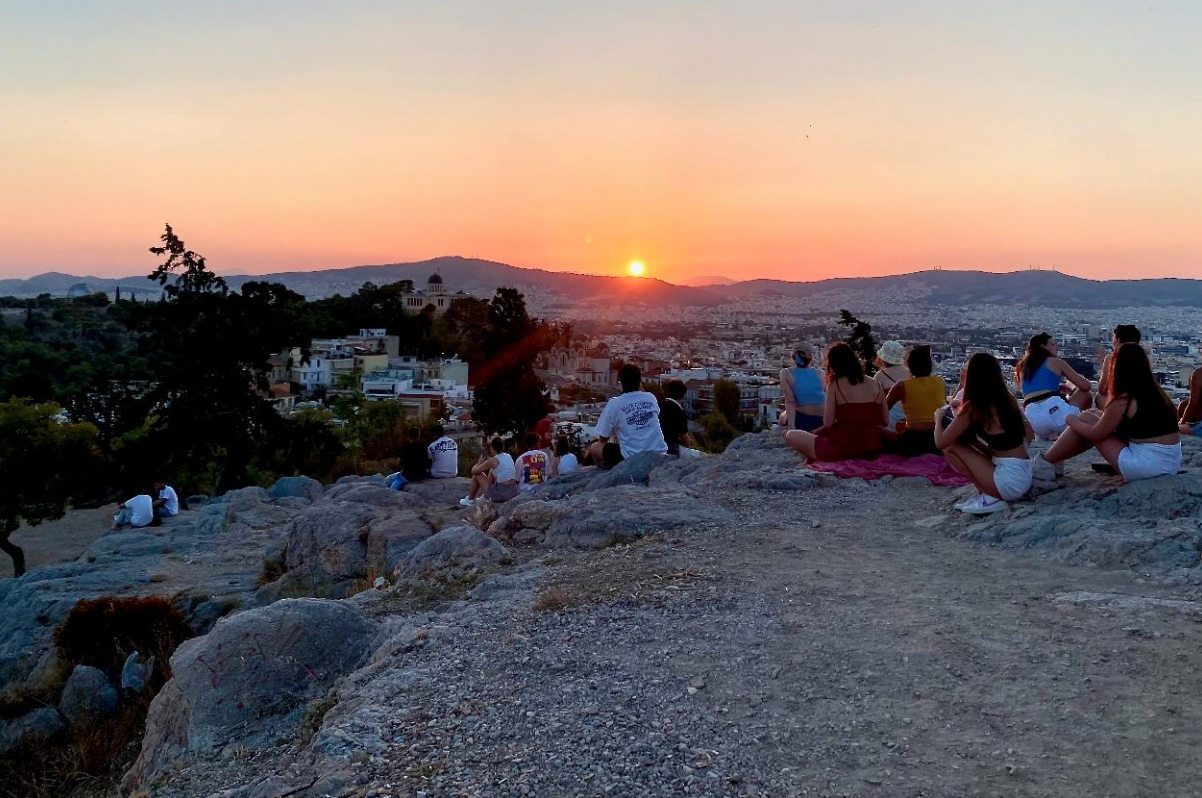
The picture on the front of today’s order of worship is the sunsetting on the Areopagus in July 2023. Grace and I ended up there almost by accident when we went to Athens on our honeymoon. This Mars Hill is a high-point in the city, and what you can’t see in this picture is that it sits right beside the remnants of the ancient Parthenon, a temple dedicated to the goddess Athena. The Areopagus wasn’t on our itinerary, but when we got to Athens it was over 100 degrees every day we were there. And so we decided to only go out in the early morning and the evening. The best place to watch the sunset in Athens is on top of the Areopagus, and so we went.
Paul was struck by the religiosity of the Greeks. With their big bright temples and statues dedicated to the Gods. Paul says that he knows how to develop a personal relationship with God, by reaching out and remembering that we are always living in God — not just when we are at holy sites.
In the United States, we are more familiar with the phrase “In God We Trust” — a phrase that has been printed on all American currency since 1955.
We are less familiar with the phrase “In God We Live” that Paul quotes to the Athenian philosophers.
What does it mean to live in God?
Does Paul mean it literally? People today use the term pantheism to describe the belief that God and the Universe are the same thing — everything that is, is God. If God is everything, then we live in God.
It seems this is not what Paul means when he says “In God We Live,” when he is atop the Areopagus.
He’s saying something like: do as I say, not as I do.
His life as presented in the New Testament is fairly tempered. But he is teaching everyone to live every day like it is a miracle, like you are part of the life of God.
Among any group of people you meet, there are going to be people who have experienced miracles.
Perhaps some of us here have been party to miracles — special experiences that defy expression in ways that leave you without words to describe what you have experienced. I know I’ve been part of a few. Miracles are generally events that feel like they go against or defy some law of physics — they feel outside of life. Paul says remember that we are part of God, whose existence is a miracle, and whose hope for us is miraculous.
It all leads me to believe that we, the readers and experiences of scripture, are intended to be the emotional register of the Bible. Scripture is the invitation. We are the ones who make Jesus’s ministry and Paul’s dialogues real.
So live in God. Today and always.
May it be so. Amen.

