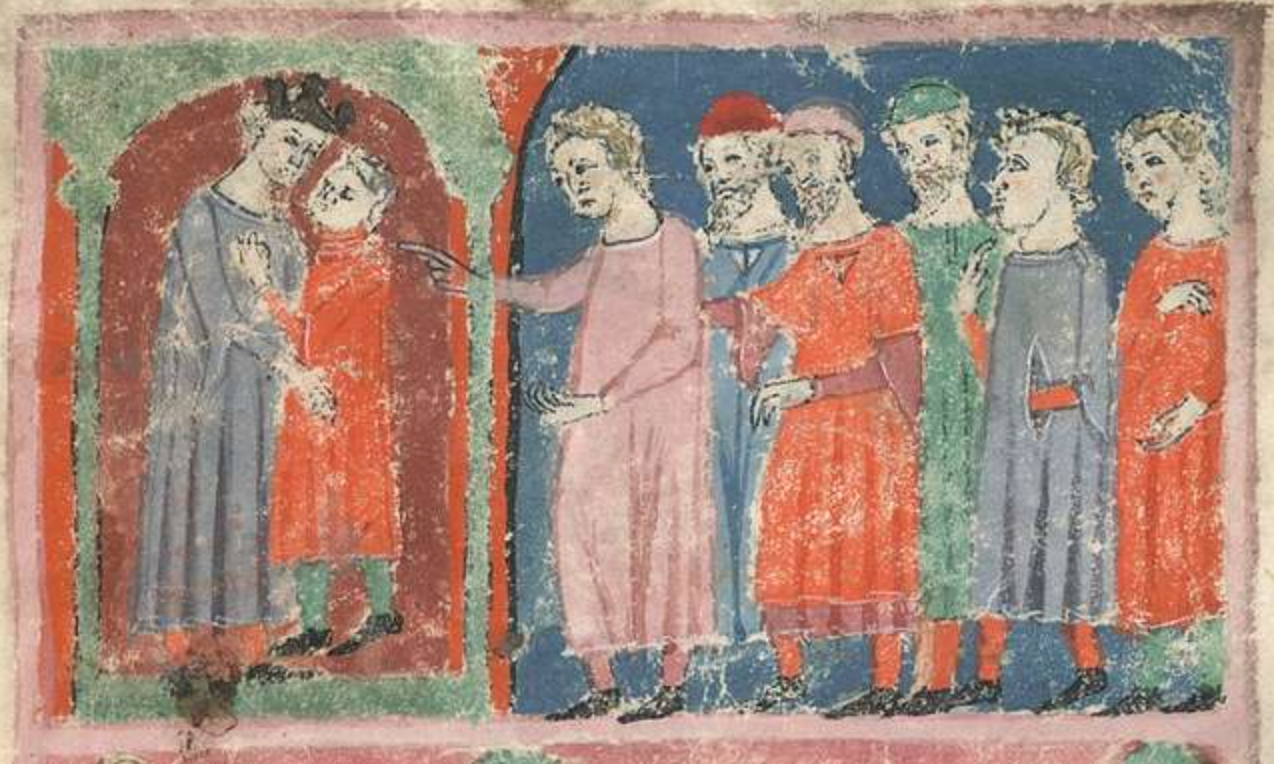
Scripture: Genesis 45:1–15
Joseph comes to us this morning across the millennia and from behind the fog of myth and history.
He’s just a child when this story begins — favored, proud, intelligent, confident, and immature.
In our reading today he’s an adult — seasoned, humble, forgiving, and in a position to lead others toward the saving of their whole civilization in the face of drought and famine.
When the sunlight hits the fog of this Joseph story, we see different aspects of this old story reflected back to us: a familiar old friend on one hand, while other aspects of this story come out of the fog of story-telling as if for the first time.
This sacred story from Genesis is the story of humanity. On one hand it has much to teach us about the generations of nomadic herders and farmers whose special relationship with God makes up the focus of this oldest of biblical stories.
But it also has much to teach us about ourselves, today: here and now. Because the best of ancient scripture poses the question again and again: how do we understand ourselves? How do we understand ourselves in relation to these stories of scripture?
And so this morning we don’t just hear again about the boy Joseph being sold to human traffickers and taken away from his family into Egypt. We see anew the big picture before us, of who sees other people as disposable in our society, today, and who, is like Joseph, is being deported, and evicted, and pursued by those in power, and locked up or cast aside in our own world. It doesn’t take much looking to find the young Joseph in our world today.
Joseph doesn’t just live once in Canaan thousands of years before the birth of Christ — but he lives and returns, again and again and again in all eras of history, until one generation can break the cycle and find balance in creation so that our desire that not just a few but rather the multitudes and masses can thrive and flourish in our world — even in the midst of a global disaster.
The names of Joseph and his named siblings in order of birth include:
Reuben, Simeon, Levi, Judah, Dan, Naphtali, Gad, Asher, Issachar, Zebulun, Dinah, Joseph, and Benjamin.
In the second year of the famine that is causing widespread loss of life, these adult brothers in Canaan hear that there is food to be had in Egypt and they leave their families in the land of Abraham and Sarah, and head south. The seriousness of the famine can be seen in the fact that all the brothers go together, leaving none behind to care for their father and extended family.
Some of these brothers’ names sound unfamiliar to us today: I know people named Reuben, and Simeon, and Dan, and then many Josephs and Benjamins. But the other names have fallen out of favor. Yet almost all twelve of these names can be found on the stones of the historic Newman cemetery across the street. Only the names Zebulun, Gad, and Napthali are missing.
Together these names mean honor, luck, and struggle —
And these are three things that Joseph relied upon when he arrived in Egypt.
Some form of honor kept him from consenting to a relationship with the wife of one of the Pharoah’s captains. Luck was that while he was imprisoned Joseph interpreted the dreams of two people who later convinced Pharoah that Joseph could interpret dreams. And struggle is what Joseph does on behalf of Egypt, by leading the people to do the hard work of storing up enough food and supplies during seven years of bumper crops so that they would all be able to survive seven years of famine and struggle.
All the while he is learning and growing as a person so that when his brothers arrive in Egypt looking for food, after the terrible things they had done to Joseph, he is able to say without a touch of malice: “I am your brother Joseph, the one you sold into Egypt!” He forgives them without even thinking about it, and shares God’s abundance with them.
He says he will “provide for you.”
Sometimes we are Joseph, in a position to share with others in their times of need. And sometimes we are the brothers, who receive pardon and forgiveness even when we don’t deserve it. This is the human story, and God’s redeeming grace playing out before our very eyes on the page, and even in our own lives.
Friends, how many of you have heard the song Alice’s Restaurant by Arlo Guthrie?
It’s a Thanksgiving tradition for many to listen to this Vietnam-war-era epic eighteen-minute song about an over-the-top prosecution of littering charges against a pair of friends in Stockbridge, Massachusetts after they get caught dumping bags of trash by the roadside after cleaning Alice’s house on Thanksgiving when the dump is closed.
There’s a famous moment where Guthrie, after telling this powerful story about Alice and the twenty-seven eight-by-ten glossy photos with the circles and arrows and a paragraph on the back of each one explaining what each one was to be used as evidence against you, Guthrie then famously says, But that’s not what I came to tell you about. I came to talk about the draft.
I feel a little of that sentiment right now as I’m talking about Joseph and his brothers. I didn’t come here just to tell you about the reconciliation of this family. I came to talk about AI.
When we think about AI today, we think about ChatGPT, Claude, or Gemini, known as large language models that process questions and reference what feels like the whole of human knowledge to give you a response. Sometimes the product is funny. Sometimes it’s amazing. Sometimes it’s exactly what we needed. But as this technology becomes more advanced and prevalent, it’s showing up everywhere in society — taking the social out of society and, taking humanity out of the human story.
In this week’s New Yorker Magazine, historian Jill Lepore writers that bots and AI agents now outnumber human participants on the internet — 57% of internet traffic is some form of automated intelligence carrying out an automated requests. Direct human activity on the internet is getting rarer. When you call a company or reach out to someone online, there is an increasing chance you’ll be communicating with a machine mimicking the behavior and style of a human. Surely some good will come from this automated revolution. But there is a great loss embedded within this change too.
I’m struck again by the fact that all of Joseph’s brothers traveled to Egypt together in search of food. They didn’t send someone else to do it. They didn’t split up into two or three groups and some stay at home and some go. They all shared each shared in the same common fate — they would either all succeed in Egypt or all fail on their mission to find food for their family.
As Pope Leo wrote in his extended essay about the pitfalls of AI in our world today, we need each other. Science and faith have always been companions on the journey of seeking God, seeking truth, seeking goodness and mercy. The current race to develop artificial technologies without a thought to the sacred humanness at the center of humanity and society will end in the destruction of something wonderful if we are not careful. No outside intelligence can truly interpret human dreams for you. No outside intelligence can empathically accompany and comfort like a human can, made in the image of God.
The book of Genesis acknowledges that humanity is not perfect, but we are perfectly imperfect — we have free will to make decisions and fail and work our way with God into a state of unearned love and forgiveness. Artificial intelligence will be powerful, but always devoid of redemption and grace and the human spark of imperfection.
Friends, I invite you to make human mistakes, and take pride in your humanness as you learn from where we have gone wrong — like Jospeh who begins as an immature child and becomes the skilled planner of a nation on the brink of chaos. Make mistakes and learn from them and embrace your humanness, because the human process of learning brings us into closeness with God, as it did for Joseph and his brothers — grace and forgiveness come in the end.
May God direct us toward paths of human flourishing — inspired by sophia wisdom — together as one human family.

