Scripture: Psalm 19:1–7; Luke 12:54–58
God with us, we pray today for a world with clouded vision — we have known the struggle to see, struggle to breathe, struggle to know when you are near — help us to take hope and courage from the roots of sacred wisdom, and enable us to find comfort and inspiration in scripture and sermon so that we might see your grace, and know your grace, and enter your grace, and in so doing, be freed to radiate your love for all the world. This morning let the words of my mouth and the meditations of all of our hearts be acceptable and filled with the Good News that you have in store for us, O Lord our rock, our tower, and our redeemer. Amen.
In the United States today there are about 450 special operation firefighters employed by the US government known as “smoke-jumpers.” These are the green berets of wildfire fighting — elite crews of airborne firefighters who parachute into remote locations to combat emerging wildfires before they begin to burn out of control.
I used to work with a former smoke-jumper, Meredith Finch, who once recommended and lent me a book called “Young Men and Fire.”
The book tells the story of fifteen smoke-jumpers who responded to a fire in a place called Mann Gulch in a remote part of Montana in August of 1949. The fire had been started by a lightning strike, and what began as a routine job to contain a few acres of fire turned into a challenging scenario as changing winds spread a fire to both sides of a canyon, cutting off the firefighters’ access to the safety of a river below. With their escape route now cut off, a wall of fire started rapidly climbing up the canyon at them.
The leader of the team, Wagner Dodge, at first ordered everyone into a running retreat up the gulch, but it soon became clear that they were not moving faster than the spreading fire.
In desperation and with no other options, Dodge saw an escape plan materialize before his eyes. He lit a match and started his own fire on the ground in front of him, which, like the main wildfire, quickly spread up the hill. He ordered his team to lay down in the area that he had just burned and breathe through cloths — but most of them thought he had inhaled too much smoke and lost his clarity of thought, and continued running up the hill.
The smoke-jumpers who laid down in the embers of Dodge’s fire watched as the main fire approached them, and then parted around them and continued up the hill in a matter of minutes. They were okay. Those who kept running didn’t make it out of Mann Gulch. Dodge’s technique became known as setting an “escape fire,” and is an established practice among smoke jumpers today.
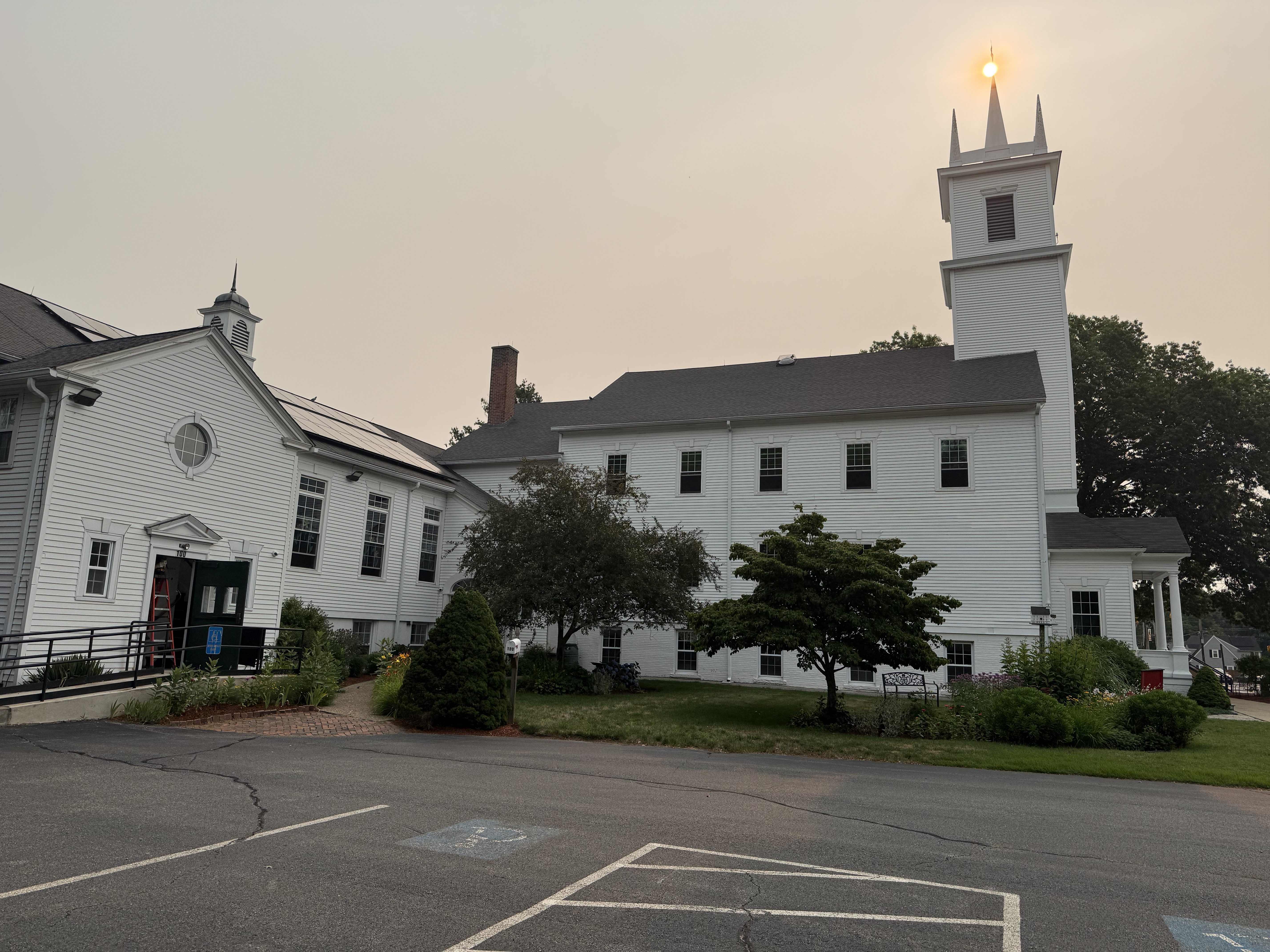
The smoky weather that began this past Wednesday reminded me of Meredith Finch’s book on wildfires. Some 200 or more distinct fires are burning in Canada and Minnesota, sending alarming levels of particulate matter into a third of all American states. This event has made Jesus’s words in Luke’s gospel all the more interesting and personal for us this morning.
In Luke’s gospel, Jesus levels a critique to the people, saying: “When you see a cloud rising in the west, you immediately say, ‘It is going to rain,’ and it rains. And when you see the south wind blowing, you say, ‘There will be scorching heat,’ and it is hot.”
Jesus seeks how the people are adept at interpreting signs in the natural world, but they have no skill in interpreting spiritual signs, or seeing the significance of what is happening in regard to Jesus’s healing ministry.
We too can see the physical changes in our midst. It’s clear for us to see that a cloud of smoke has been rising in the west, and a southerly atmospheric wind has been blowing toward us and clogging the skies. Jesus rebukes the people for knowing when it will rain and when it will be hot, but that they can’t see the specialness of his own healing ministry.
What is the spiritual activity in our lives that we are missing today? How is our spiritual perception blocked and overwhelmed by the things that are obvious in our world. The twenty-four hour news cycle is clear — the 24-hour spiritual cycle is less obvious.
Jesus ask us to interpret the spiritual dimension — he frames it as an opportunity, and a responsibility. Jesus is asking people to respond in some way to his ministry — to not continue going on with their lives as business as usual, but to take part in the kingdom of God somehow — to get up and follow him; to follow his teachings about seeing those on the edge of human society as the center of God’s story; to allow themselves to be transformed.
Wildfires in Canada are not unusual. Canada is home to ten percent of the whole world’s forests. What is unusual is how unrelenting the fires are this year — the nighttime temperatures aren’t dropping as much so the fires don’t slow down overnight. Less snowpack and less rain water means the landscape is drier than it has been. The fires are familiar and natural; the intensity and scale of the fires is unprecedented in recent history.
In the midst of this crisis of the natural world, Jesus asks us not to look away. Look to the skies, look to the wind, interpret your times — it is our opportunity and our responsibility to interpret what we are seeing and to respond like Wagner Dodge, who encountered a situation of his own certain destruction, and found a way to fight fire with fire.
Psalm 19 reflects the beauty and splendor of Hebrew poetry found in the Psalms more than any of its 150 psalm siblings. Psalm 19 declares that “God is revealed in the world of nature.” Psalm 19 asks us to seek and declare the glory of God.
The psalm praises nature for revealing something about God. Verses 1-4 celebrate revelation of God that is made possible by the skies. Verses 4-6 celebrate the revelation that happens through appreciating the sun.
It’s a reminder that the world is our teacher, even when it is in pain.
What will we learn? How will we respond?
What is the nature of our escape fire, like Wagner Dodge?
Last Wednesday and on other days this past week, the sky and the sun were obscured by smoke. The appreciation of God’s revealed love was made harder to see. Perhaps what is being revealed, with the help of psalm 19, is that God’s creation is injured right alongside us, and God’s grace is part of the connective tissue still holding everything together — like the smokejumpers starting small fires so that they can do the larger work of keeping whole wildfires from spreading.
Let us continue to be people of hope, connected to the lifegiving waters of God through the revelation of this burning world — God is not perfect and neither are we. In our imperfection, we experience the grace of God, and set a new course forward despite of it.
Thanks be to God. Amen.

