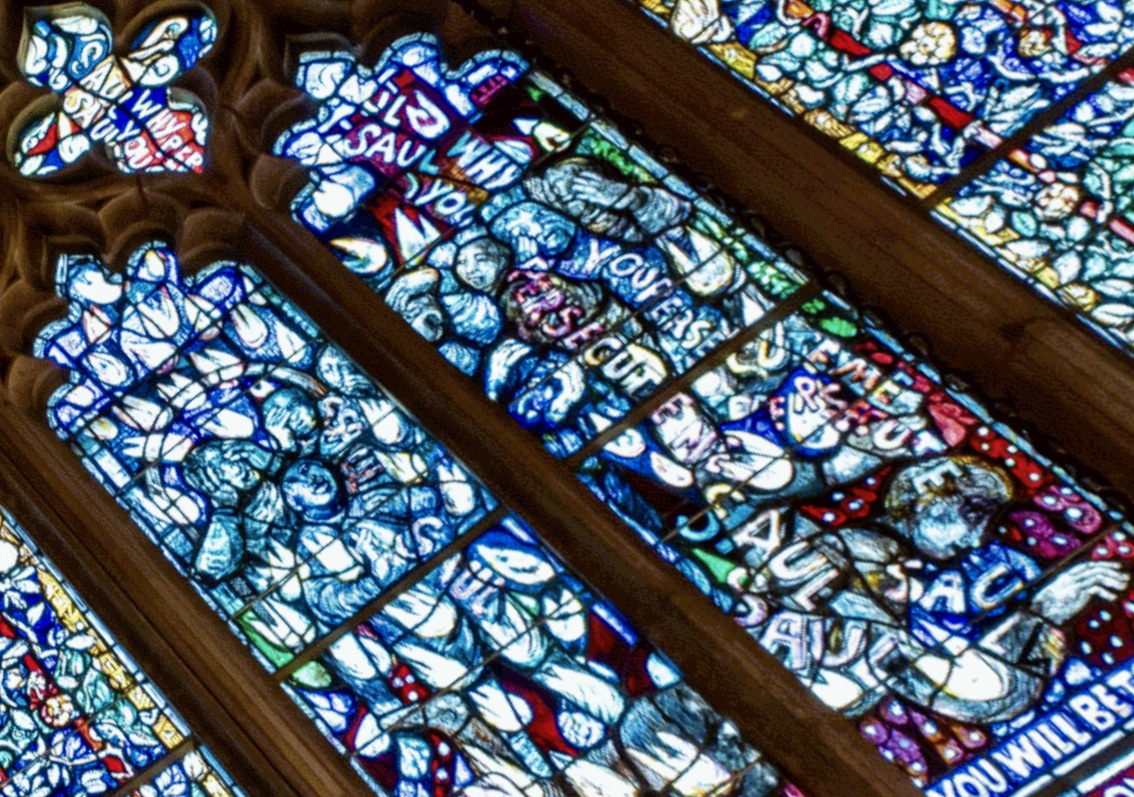
Scripture: Acts 9:1–19
The most famous conversion story in history is the one we have just heard — that of Saul of Tarsus, who becomes Paul the Apostle.
And I should know a thing or two about Paul having worked at St. Paul’s School — named for Paul the Apostle — in Concord New Hampshire for several years. The windows on the front of our order of worship today are from the chapel at St. Paul’s, depicting the moment of Paul’s conversion.
I remember asking one of my colleagues why they thought the founders of this school had chosen to name their school for St. Paul when most other schools are named for the founder themselves, or for a town name.
My colleague said that the choice was in homage to St. Paul’s Cathedral in London. Which is interesting, but feels like only the beginning of an answer.
And you could ask the high school students about the man whose name they all wore on their sweatshirts and water bottles and sports uniforms, and some would say they hadn’t considered the fact that Paul was an actual person.
And someone would ask a question, like, why is our school mascot a pelican? New Hampshire is one of the last places you would find a pelican . . . the reply would be that Paul liked pelicans because they were said to be sacrificial birds and Paul appreciated those who made acts of service.
In short, Paul is something of a mystery, an enigma, even to those who should know him best. Which makes sense for the man who wrote “I have become all things to all people, for the sake of the gospel.”
This new and unexpected character joins our year-long journey through the Bible that started back in September.
At the beginning of today’s reading, we meet Saul for the first time, a Greek-speaking Jewish-Roman citizen and self-described persecutor of the earliest Jesus followers in the years just following Jesus’s death.
But as he traveled along the now-famous road to Damascus, Saul is confronted by a jarring vision of the risen Christ who rebukes Saul for his violent behavior against Jesus’s followers and puts Saul onto a path that makes him Christianity’s biggest booster, and also leads him to take on the name Paul.
Paul and Jesus never met each in life, though they were born in about the same year, Jesus in Bethlehem and Paul in what is today southern Turkey. Paul is worldly and well-traveled in a way that contrasts Jesus who was oriented to Jerusalem and its surrounding areas. Paul benefits from the protections and benefits of citizenship in the empire, whereas we remember that all Holy Week is about how Jesus the non-citizen is vulnerable to the empire that ultimately kills him. As such, Paul lives twice as long as Jesus.
As the name suggests, Christianity is ostensibly a religion about Jesus the Christ — today, leaders argue about who Jesus would side with, leading the head of the Catholic Church and the head of the Anglican Church to link up in mutual support of each other in ways that are powerful and have not always been the case. No one really wonders about who Paul would support today. But as many scholars will tell you, there would be no Christianity today without Paul.
We have read and explored the entirety of John’s Gospel from December to April this year — it is a soaring gospel that brought us into the high peaks of Jesus telling the world who he is and performing beautiful miracles and offering timeless statements in clear and straightforward ways. It is the ultimate sacred poetry and prose.
And so it can feel a little jarring after spending so much time in John’s Gospel to learn that our journey through the Bible ends with a series of twenty-one letters, thirteen of which are supposed to have been composed by Paul, and eight of which scholars believe were actually composed by Paul.
It is worth noting that in the “definitely-Paul” letters, Paul makes positive statements about women playing an active role in the new Christian Church, he supports a church that is universally open; whereas in the forged letters, the author is openly gender biased and dismissive of women. He writes about the particular concerns of first-century dockworkers, and the diets of people in Corinth, but that doesn’t apply to most of us.
This leaves many of us unsure what to believe about Paul and these letters, and uncertain about how to hold or thing about this epistolary part of the letters in the Bible.
Some of us choose to deemphasize Paul and say that our faith rests upon the Gospels and the wisdom that precedes them, not follows them. But to deemphasize Paul is to take some of the most important statements about the meaning of love in the Jesus tradition out of the Bible. One of Paul’s innovations is to connect Jesus to putting love into action, saying that love patient, kind, and humble.
Sometimes it’s helpful to look beyond Paul in these letters about the early church and try to see through the haze of history what the lives of these early Jesus followers who were gathering in homes and living rooms, trying not to draw the notice of people like Saul who opposed them. How powerful it is to be told that God is love in action, finding a way to come to you across all the warring forces and confusion, acting with your best interests at heart.
Think about this story of Paul on the road to Damascus — Paul is injured and shaken and afraid in a city he does not know, and the major event in the story is that God sends him a healer and a friend in the form of Ananias of Damascus. This story reminds us of all that is happening outside of the scope of our own experiences — the human story that is playing out in ways that will shape our life and it brings comfort to think that the substance of love and warmth is at the center of this human enterprise.
The story has a reciprocity. Paul is offered loving kindness from someone sent by God, and then goes and does likewise. This is the model for us all — to be sources of love in the world, knowing that the more we love, the more love we receive.
May God go with us down the road to Damascus, and into the city, and into the unknown future, sheltering in God’s love.
Amen.

