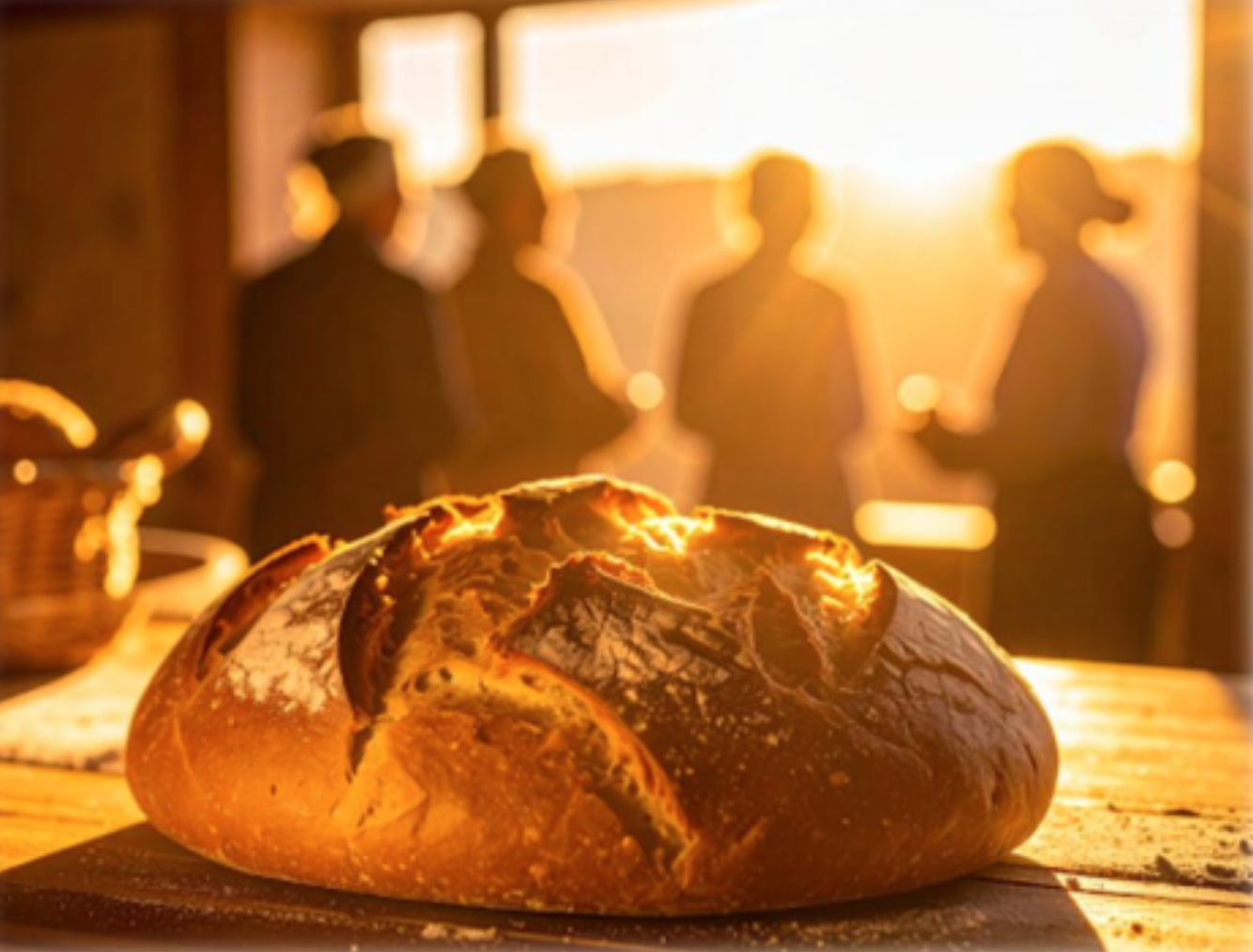
Scripture: Matthew 13:33
Easter passes unto to Pentecost, moving onward into ordinary time . . .
June jumps to July and August arrives . . .
This is the natural course of “business-as-usual”: seasons and months passing unto seasons and months.
We call this business-as-usual and we feel it deep in our humanness, this experience of living in these circles and cycles.
But we know that from time to time (and sometimes too often), there are moments that disrupt our experience of business as usual. The paradigm shifts of life — a major setback, the birth of a child, or the loss of a loved one, a long-awaited breakthrough . . . These are moments that take us out of business-as-usual and from which we do not return to the familiar circles and cycles right away.
In these moments we take time to recognize the power of life and death, and the overwhelming sacredness of these very thick human experiences — they are sacred because God is with us.
It is a common belief that Jesus’s parables — his teachings about life and death and the kingdom of God — are meant to break us free from business as usual and startle us into a sacred realm — a sacred mindset — and a transformed living. His parables are intended to startle listeners into seeing life from new angles.
The Bible tells us about 40-ish such lessons from Jesus, with gospelers Luke and Matthew reporting the majority of them.
Our parable of focus this morning is told in both Luke and Matthew. We read Matthew’s version just a moment ago.
In just a sentence: “The kingdom of heaven is like yeast that a woman took and mixed in with three measures of flour until all of it was leavened.”
That’s it . . . Did anyone feel transformed by this reading?
Did anyone feel themselves shaking free from their business-as-usual?
Over the next five weeks we’ll study five parables of Jesus; I wanted to start with this Parable of the Leaven, on one level, because it’s short . . . and because it’s sneaky in the ways that Jesus’s teachings can sneak up on us and shake us into another way of being and living.
To appreciate the fullness of the parable, we start with the yeast. The yeast of this parable is not a neat powder — this yeast of biblical fame instead is what we would call a sourdough starter — a pungent natural fermentation that comes from a mixture of flour and water interacting with bacteria and transforming into something live that will create chain reactions.
In 2020, when more-people-than-usual were experimenting with making sourdough bread, I tried my hand at making kombucha, which relies on the same messy process of fermentation. I received a SCOBY (a lump of bacteria and yeast) from colleague, put the yeast mixture in a glass jar and tucked it away in a cabinet for a few days to do its work. When I came back, the jar had overflowed and the sweet moldy smell had taken over the whole cabinet (and then, by extension, the whole house). I came to appreciate the smelly power of a yeast reaction.
This power of yeast helps us remember that Jesus’s audience may have thought of yeast as a bad or uncontrollable thing; they may have associated yeast with the corrupting power of empire. Yeast is also unnecessary for bread, as the tradition of making unleavened bread at Passover can attest to. But Jesus is clearly talking about yeast as something good in this parable — it is the key to the Kingdom of God.
Another yeasty story to help us along the way — this past week I read a book about baseball called Bottom of the 33rd by journalist Dan Barry.1 Baseball fans and non-baseball fans alike will tilt their heads in confusion at this book title and say that baseball only has nine innings, unless they are familiar with Pawtucket and the story of the longest professional baseball game in history.
In 1981, the Rhode Island minor league affiliate of the Boston Red Sox played a baseball game in Pawtucket on the night before Easter against a team from Rochester New York.
Dan Barry writes about the intense yearning and longing of all the minor league players, who all felt they were a few good plays or homeruns away from punching their ticket to a big league team. Cal Ripken Jr. who played in this game was quoted as saying that when he was in the minor leagues, every pitch felt like it was a full count in the bottom of the ninth in game seven of the World Series.
This yearning is why none of the players let up the intensity of their playing as this game extended from 8pm to after 4am on a cold April morning; it is why when the away team scored a run in the top of the 21st inning, Wade Boggs drove in a game-tying run when he could have just struck out and ended the game.
The yearning of these players to show their best selves meant that they were able to accomplish something extraordinary when other players would have called it a night. (For the record, the Paw Sox ended up winning this game).
This is the spirit of the Leaven parable; the woman has added a little bit of leaven, a little bit of longing, to a huge amount of flour, and the whole normal mixture has been transformed into something wonderful by the effort of the few.
There is abundance in this parable. There is flour enough to make bread for dozens of people. Forty to sixty pounds of flour have been unlocked and transformed by a little yeast.
“The kingdom of heaven is like yeast that a woman took and mixed in with three measures of flour until all of it was leavened.”
The Greek word for “mix” in this passage is enkrypto. The woman of the Kingdom of God is mixing yeast into flour in a way that we would call “encrypted” — her work is hidden. Her baking is being done in secret, though the result of her work will be unmissable and undeniable to all.
Friends, we too are doing encrypted baking. We are creating the world of the future by remembering that Jesus is bread to the world, and remembering him at the table when we take communion, and remembering that another way of living is possible.
But right now, the world’s bakery is a contested space. It can feel like we’ve lost the recipe for how to make bread and there is an argument going on about how to do it. Add this ingredient, scrap that ingredient.
The stakes feel very high for who wins this argument. People need to be fed; we need to turn down the heat of the oven. But remember that there is a natural process of fermentation at the heart rising bread. It is an out-of-control process that is out of human control — the heart of the kingdom of heaven is a process we cannot complete — we can only learn to channel it. It happens naturally. We channel the kingdom vision of Jesus when we stay engaged; stay hopeful; when we keep playing even if the game is stuck in extra innings; the true nature of our work is hidden like the yeast, the longings of our love; the bread at the heart of creation. May we keep transforming.
May is be so.
Amen.