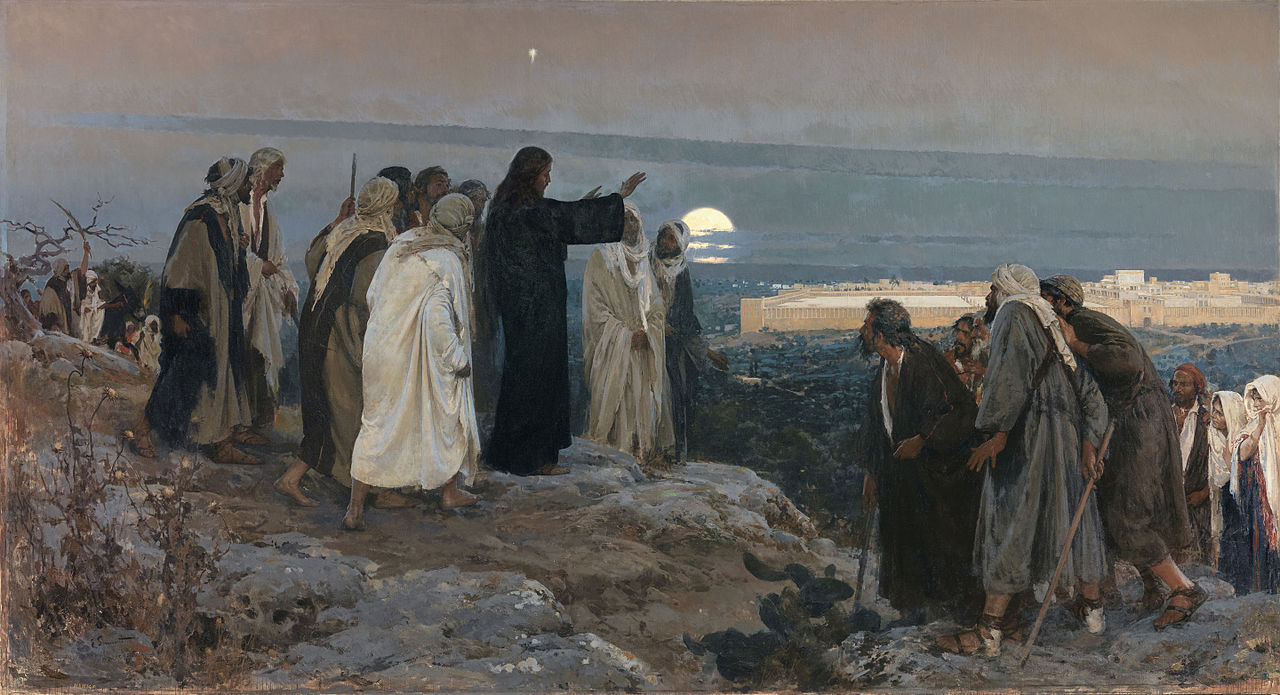
Scripture: Luke 19:28–40
From the threshold of the Dark Wood, we have arrived at the threshold of Jerusalem, the holy city where this journey with Jesus has been heading all along.
We can imagine ourselves, foot-travelers standing with Jesus and his friends, looking down at the walls of the city1 and daydreaming our final arrival, which is the right and pastime of all travelers and adventurers, everywhere and always, nearing journey’s end.
A few weeks ago, Suni Williams was coming home from ten months on the International Space Station, a longer-than-expected stay in outer space, and she said the first things she wanted to do when she got home were to hug her husband, hug her dogs, and have a grilled cheese.2
Remember that Jesus’s group of traveling companions are seasoned walkers — they have arrived to cities and towns so many times over the past three years after days of sleeping in fields under the stars; they know the practice of making arrangements for their arrival.
For me, while hiking in the White Mountains, there are a few rituals that always happen as a long hike comes to its close. The high mountains and their soul-soaring views are behind you; toward the end, you start thinking about simple things — how good it will be to bathe and remove the dirt and dust from your body (the equivalent of Jesus washing his friends’ feet at the last supper); you think about how good it will be to change your clothes; and about how good it will be to share a celebratory meal.
The meal is the most important part. There are a select few special restaurants where I go with hiking companions after every hike — every time I go to one of these places, I am reminded of all the other times that I have been there. The post-hike meal is really one continuous meal. You are reminded of all the other occasions, times you have stumbled into the warm restaurant, tired after a long day, cold from snow or rain, maybe shaken from a close call, but always with a sense of triumph for having been to the mountaintop and back.
So too with Jesus as he nears Jerusalem. He starts scheming with his friends about how to get to their post-hike destination: in this case on the back of a donkey. He gives them instructions for how to find a room where they can share a Passover meal. While approaching the end of their journey, they are thinking about what is next, and getting ready for it.
But the major part of this Palm Sunday story is the thing that Jesus and his friends can’t plan for — it’s the will of the people of Jerusalem.
Remember that Jesus was born into an empire, controlled by a man named Herod who sought to kill Jesus. And the people of Jerusalem and surrounding area are still vulnerable subjects of an empire (still controlled by a man named Herod). The people, hearing of Jesus’s arrival, decide to send up a distress signal to Jesus, the one they know who cares for them.
When you become lost in the mountains, one of the worst things you can do is wander aimlessly in search of your trail. If you are truly lost, there are a few strategic things you can do to help your situation: mark your territory by starting a controlled fire; hang bright objects from the trees, so that you become visible to other people; and blow your whistle — three short blasts is the universal distress signal.3
The people of Jerusalem, living in the grip of empire, follow these survival instructions to a T as Jesus arrives. In lieu of a fire, they make themselves most visible by making a massive crowd around Jesus as he comes to the city; they throw their clothes and palms onto the road to make his way to them visible; and instead of the three blasts of the whistle, the people shout a three syllable Hebrew word: hôšî–â-nā. By which they mean, save us.4
Jesus and his followers can’t help but see that the people are asking Jesus — not the general, not the judge, not the governor — to help them.
Jesus, the misfit, has come to save. Let’s rewind for a moment to the beginning of our Lenten journey, back on March 9, when we read about Jesus coming out of the wilderness after forty days and going to his hometown to begin teaching and healing the people there.5 Remember that when he started teaching, the people wanted to throw him off a cliff because his words are controversial.
Jesus had said, “Change your way of thinking! Heaven is already here.”6
Said another way, Jesus was saying — “if you have conformed yourself to the powers of this world, and what King Herod and the Roman Empire want you to do,” Jesus says, “it is time for you to become ‘miss-fit’ to this world. Become a misfit in empire; become unashamedly your authentic self, because any other way leads to devastation and hollowness.”
Hence the gifts of the misfits are the heart of Palm Sunday. The palm-wielding people are embracing their status as misfits as Jesus arrives.
Palm Sunday is when we realize the complicated truth of what Jesus was preaching in his hometown — that, broken though we are, heaven is already here.
This is the countercultural heart of what Jesus is saying. Heaven is the here and now.
You can hear the objections:
“How can heaven be here when we are hungry, and homeless, and helpless, and living on the edge of destruction?”
Jesus responds with the Beatitudes. These are his beliefs that the promises of heaven will be made real7:
- Jesus says, those who are poor will receive blessing;
- Those who have lost a loved one will find deep blessing;
- Those who are experiencing persecution will find justice.
These are not the passive promises of cause and effect; they are promises that heaven will be real if the people make it so.
If people give the blessings of heaven, we all receive it.
Or should I say, if the misfits give it, we all receive it. Because King Herod is not in the business of blessings.
Heaven on Earth, if we are to make it, will always be the creation of misfits.
Friends, heaven is here, right here and now, maybe not it its fullness but in all of its glorious potential. The people in Jerusalem asking Jesus to save them saw the truth of this.
Can we too believe this complicated good news of Palm Sunday?
The palms and the hosannas remind us of our needs amidst the fraying edges of the world; the cracked justice; the riven families; the damaged earth. There is a crack in everything, that’s where we can see heaven drawing near, if we can make it so.8
Heaven is in the Dark Wood.
Hosanna!
Amen.